
Every property and Starlink project is different. This guide explains the practical factors considered during professional installation and helps you prepare informed questions before work begins.
Three dishes for different jobs
Mini, Standard, and Performance all connect to the same low-Earth-orbit Starlink network, but they are not interchangeable versions of one product. They differ in physical size, power requirements, environmental durability, field of view, networking arrangement, mounting choices, and price.
The best kit is the one that matches how and where it will be used. Paying for the largest terminal does not automatically improve ordinary home Wi-Fi, while choosing the smallest terminal for a demanding permanent site may create unnecessary limitations.
Mini: portable connectivity for travel
Starlink Mini combines a compact terminal and built-in Wi-Fi into one travel-friendly unit. Its lower average power use and support for flexible DC or compatible USB power arrangements make it easier to operate from an RV, campsite, vehicle power system, or portable battery than the larger kits.
Mini is strongest when portability matters more than maximum network capability. It can be quickly placed on its kickstand for stationary use and paired with eligible Roam service. Its compact size also means more modest Wi-Fi coverage and fewer built-in networking options than a full home router, so larger spaces may need additional equipment.
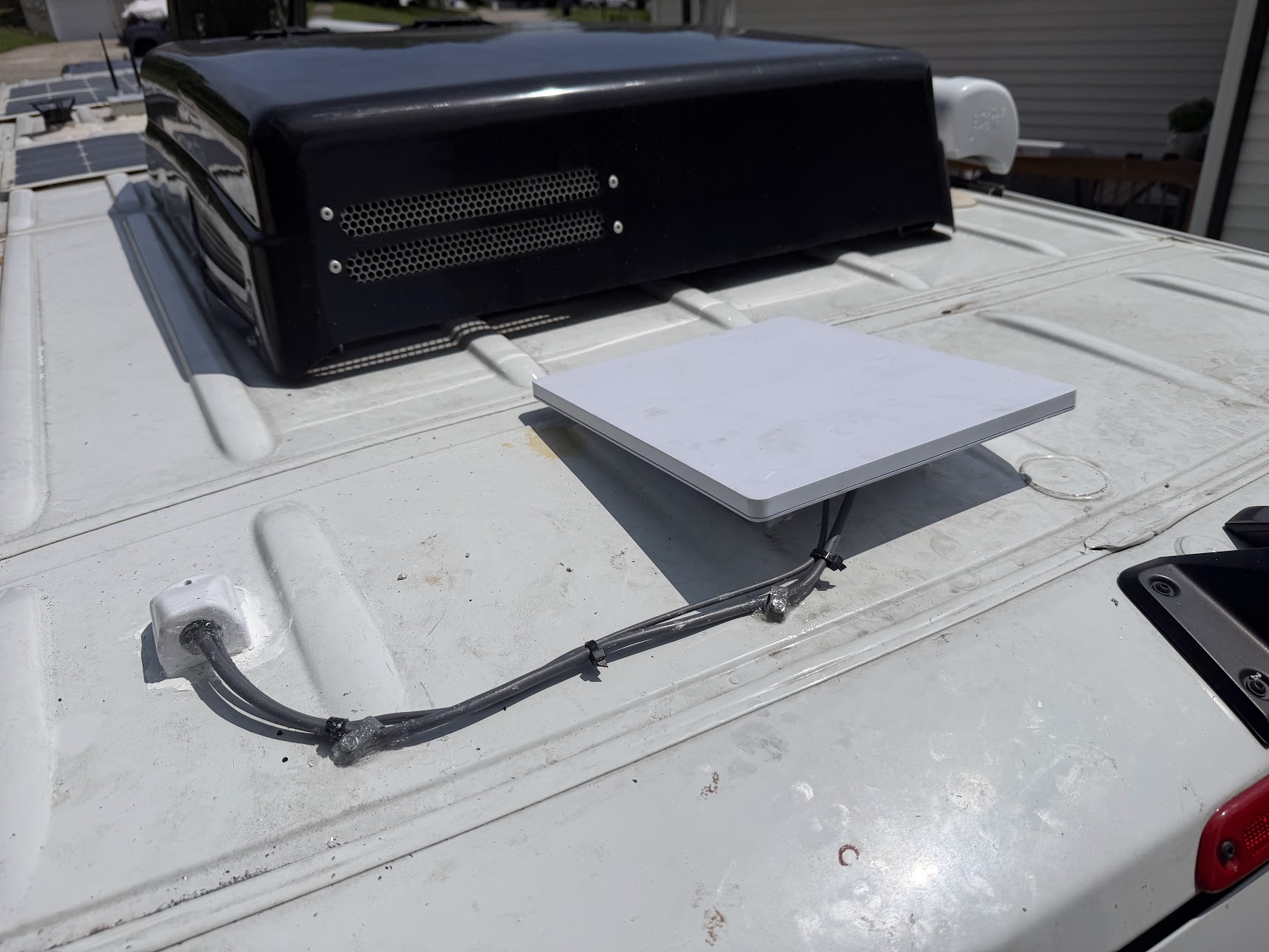
The Mini has a fixed roof position with the cable secured toward an entry fitting. This is a mounting example; a roof installation alone does not establish approval for use in motion.
Installation and photo: Mann's Starlink Contracting · View full photo ↗Standard: the normal choice for a home
The current Standard Kit is designed around residential internet. Its larger terminal and separate Router 3 provide a practical balance of connection performance, Wi-Fi coverage, Ethernet connectivity, mounting options, and price for a permanent house installation.
Standard works well for streaming, remote work, gaming, smart-home equipment, and typical family use when the dish has a clear view of the sky. It is also capable of travel with an eligible plan and safe mounting, but it is larger and consumes more power than Mini.
Need help with this on your Starlink system?
Mann's Starlink Contracting provides owner-installed service throughout Kentucky and an 11-state region.
Performance: built for demanding sites
The current Performance Kit is the premium, ruggedized option for enterprise, commercial, mobility, and harsh-environment applications. Its wider 140-degree field of view can see more sky than Mini or Standard, providing more satellite opportunities and stronger handoff resilience. The terminal and power equipment are designed for broader environmental and power-system requirements.
Performance costs substantially more because the value is durability, field of view, higher peak capability, mobility support, and operational resilience—not simply a promise that every speed test will be faster. It is often selected for businesses, critical remote sites, commercial vehicles, vessels, and locations where downtime is especially costly.
Field of view, power, and networking
Mini and Standard use a field of view around 110 degrees, while Performance expands that to 140 degrees. A wider view is useful when the system needs more possible satellite paths, but every model still benefits from open sky. No dish can reliably beam through dense trees, roofs, or other solid obstructions.
Mini uses the least power and includes its router in the terminal. Standard uses a separate home router. Performance uses more substantial power and networking hardware that can support advanced commercial designs. Exact accessories and power options should always be confirmed for the specific generation being purchased.
Which model should you choose?
Choose Mini when you prioritize compact size, low power use, and easy travel. Choose Standard for most permanent residential installations and general-purpose home connectivity. Choose Performance when the project requires a wider field of view, greater environmental durability, business-grade mobility, or stronger operational resilience.
Service plan matters as much as hardware. A Performance terminal on a basic or congested service plan cannot create unlimited network capacity, and a Mini on the correct plan may be the better solution for a traveler. Evaluate the dish, plan, router, mount, and power source together.
Get a personal installation estimate.
Send your location and project details. Caleb will discuss your equipment and mounting needs, then confirm your complete quote before scheduling.
Questions first? Call Caleb directly at 270-940-4866.
Written byCaleb MannOwner and installer at Mann's Starlink Contracting. Caleb works directly with customers from project planning through final system setup.
