
Every property and Starlink project is different. This guide explains the practical factors considered during professional installation and helps you prepare informed questions before work begins.
Two very different installation styles
An RV Starlink can be permanently attached for fast daily use or carried as a portable system that is placed after parking. Permanent mounting prioritizes convenience and protected travel. Portable mounting prioritizes flexibility and the ability to move the dish around trees or campground obstructions.
The right choice depends on the dish model, Roam plan, RV construction, travel frequency, storage, power, and how often the customer camps beneath tree cover.
Permanent roof mounting requires planning
Every RV roof penetration can create a long-term leak or structural problem if it is poorly placed. Before drilling, the installer must identify roof framing, membrane type, interior wiring, air-conditioning ducts, slide mechanisms, solar wiring, and the exact cable-entry path.
Mounting hardware, fasteners, backing, sealant, and adhesive must be compatible with the RV roof. Adhesive alone should not replace required structural fastening unless the approved mounting system specifically calls for it.
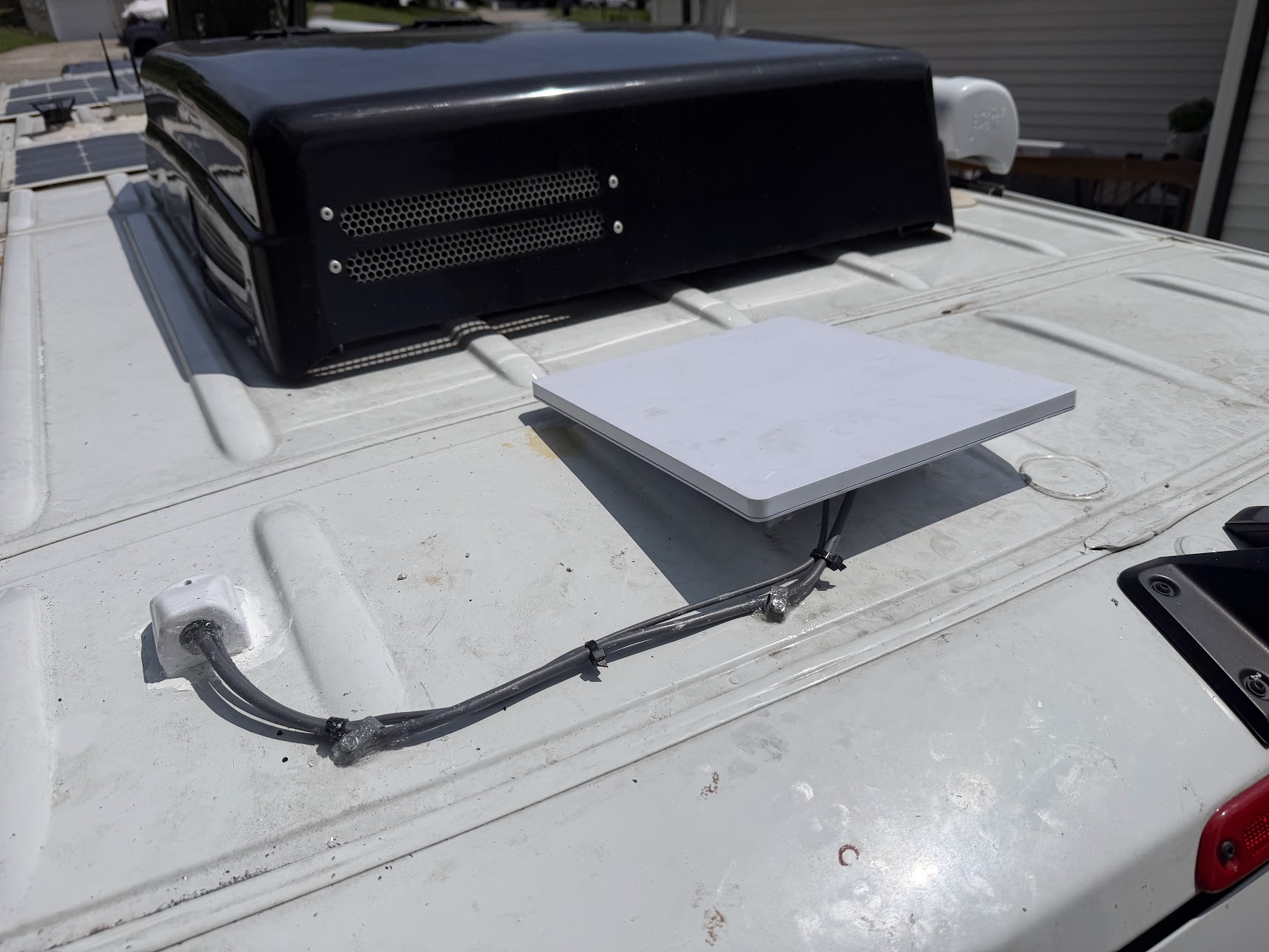
The Mini has a fixed roof position with the cable secured toward an entry fitting. This is a mounting example; a roof installation alone does not establish approval for use in motion.
Installation and photo: Mann's Starlink Contracting · View full photo ↗Keep the dish inside the travel envelope
A fixed terminal should be placed near the protected centerline of the RV when practical, with no part extending beyond the roof edge. This reduces the chance of branches, signs, or roadside objects striking the dish. It also keeps the added load away from vulnerable corners.
The exact geometric center is not always possible because of vents, air conditioners, solar panels, and framing. The final location must balance protection, open sky, structural support, heat clearance, and roof access.
Need help with this on your Starlink system?
Mann's Starlink Contracting provides owner-installed service throughout Kentucky and an 11-state region.
Cable routing and weather sealing
Exterior cable should be supported against wind and vibration, protected from sharp roof edges, and routed away from moving slides and hot exhaust components. The roof or wall entry requires compatible pass-through hardware and layered weather sealing.
RV roofs flex and experience temperature change, road vibration, and standing water. Sealants should be inspected periodically and after long trips or severe weather.
Portable kickstand and tripod setups
The supplied kickstand or a stable tripod allows the dish to be moved away from trees and parked vehicles. This is valuable at wooded campsites where the RV roof itself has poor sky visibility. The system can also be stored indoors while traveling.
Portable setups require work at every stop. The dish can be tripped over, stolen, moved by wind, damaged by vehicles, or placed where the cable crosses a walkway. Use a stable base, safe cable path, and location protected from traffic.
Choose around real travel habits
Permanent mounting fits customers who want fast connection, travel frequently, and usually park under open sky. Portable mounting fits customers who camp beneath trees, want zero roof penetrations, or prefer to protect the dish in storage while moving.
Some travelers combine both approaches with a secure permanent travel mount and a separate portable option. Whichever method is selected, never travel with a kickstand or tripod left loose outside the RV.
Get a personal installation estimate.
Send your location and project details. Caleb will discuss your equipment and mounting needs, then confirm your complete quote before scheduling.
Questions first? Call Caleb directly at 270-940-4866.
Written byCaleb MannOwner and installer at Mann's Starlink Contracting. Caleb works directly with customers from project planning through final system setup.
