
Every property and Starlink project is different. This guide explains the practical factors considered during professional installation and helps you prepare informed questions before work begins.
Starlink does not need one fixed satellite
Starlink terminals use a phased-array antenna to electronically steer communication as low-Earth-orbit satellites move across the sky. This gives the system far more flexibility than a traditional dish aimed at one distant, stationary point.
That beam steering is a major advantage on rural properties, but it does not allow the signal to pass through trees. The dish still needs a broad working window where satellites can be followed without repeated blockage.
Why trees create interruptions
Leaves, branches, trunks, and wet foliage can block or weaken the radio path. When a satellite moves behind a tree, the terminal may switch to another available satellite, but a dense canopy can block too much of the usable sky for every handoff to succeed.
The result may be short outages rather than a total failure. Those interruptions can be especially noticeable during video calls, online gaming, remote desktop sessions, security-camera uploads, and other real-time uses.
Find an opening, not just one direction
A small patch of visible sky may not be enough because satellites cross a large area. The Starlink app's obstruction tool should be used at the proposed height and location. A clearing, roof edge, pole location, or side of the home may provide a better working field than the most convenient mounting point.
Seasonal change matters. A location evaluated in winter can become obstructed after leaves return, and young trees may grow into the field of view over time.
Need help with this on your Starlink system?
Mann's Starlink Contracting provides owner-installed service throughout Kentucky and an 11-state region.
Height can help—but has tradeoffs
Raising the dish above a nearby roofline or lower branches may create the necessary clearance. Roof, wall, under-eave, ground-pole, or custom pole mounting can all be considered depending on the property.
More height also increases wind exposure, access difficulty, cable-routing complexity, and maintenance risk. A very tall pole is not automatically the best answer if a shorter, better-positioned location provides a cleaner opening.
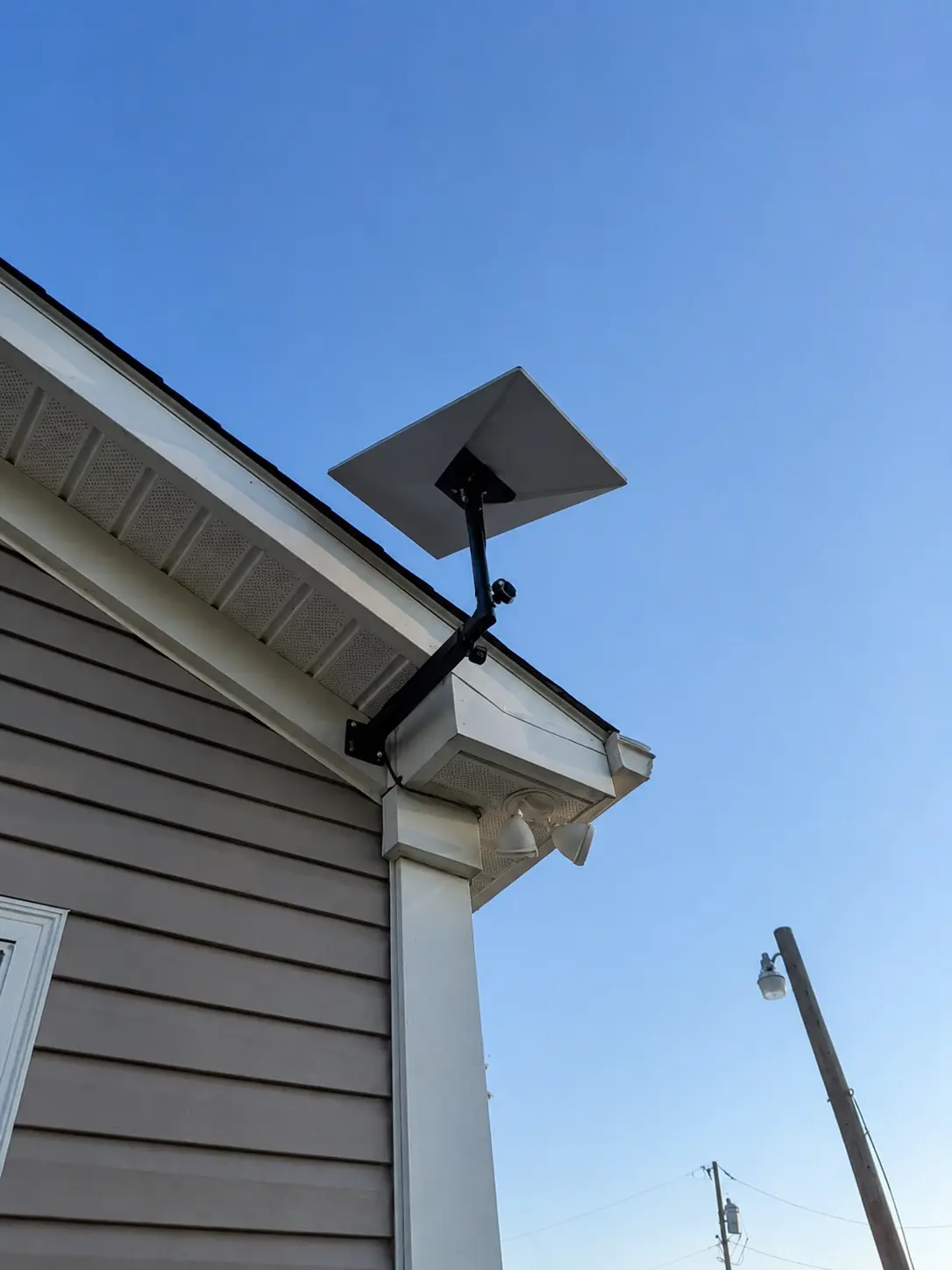
The bracket places the dish above the roof edge while the cable follows the outside of the house. Check the attachment and sky view for the actual property.
Installation and photo: Mann's Starlink Contracting · View full photo ↗Read the obstruction map over time
After installation, the app builds an obstruction map from actual operation. Concentrated red areas reveal where trees or structures block expected satellite paths. A system may appear fast during a short test while still recording obstruction-related interruptions throughout the day.
Allow the map time to develop, then compare it with outage history. Consistent red clusters near the canopy are stronger evidence than one isolated point.
When a site survey is worthwhile
Dense woods, mountain terrain, several buildings, long cable routes, and limited safe access are strong reasons to complete a site survey before permanent mounting. A survey can compare realistic heights and locations before drilling or purchasing custom hardware.
Starlink can serve many wooded properties successfully, but the winning design is usually the one that deliberately creates open sky rather than expecting the technology to overcome solid obstructions.
Get a personal installation estimate.
Send your location and project details. Caleb will discuss your equipment and mounting needs, then confirm your complete quote before scheduling.
Questions first? Call Caleb directly at 270-940-4866.
Written byCaleb MannOwner and installer at Mann's Starlink Contracting. Caleb works directly with customers from project planning through final system setup.

