
Every property and Starlink project is different. This guide explains the practical factors considered during professional installation and helps you prepare informed questions before work begins.
Why commercial roofs favor no-penetration options
Large commercial buildings often have flat membranes, dense metal roofing, active warranties, and strict rules about roof penetrations. A ballasted or seam-mounted system can avoid drilling through the main roof surface while still placing Starlink above nearby obstructions.
No penetration does not mean no engineering. The mount still needs to resist wind, distribute weight, protect the roof, preserve drainage, and remain accessible without becoming a trip hazard.
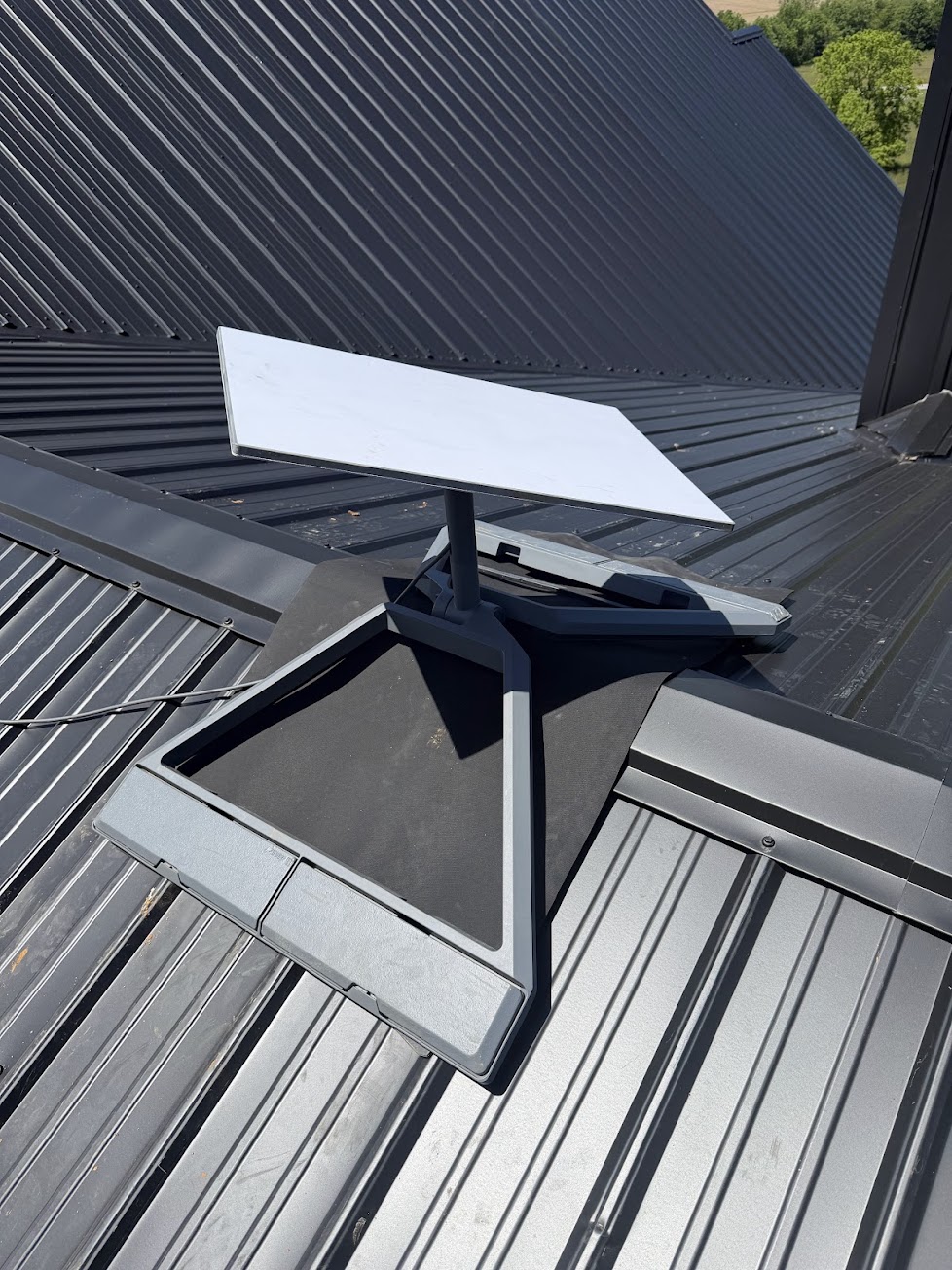
This mount spans the roof peak instead of using a wall bracket. Roof suitability, ballast, and wind requirements must be checked for the selected mounting system.
Installation and photo: Mann's Starlink Contracting · View full photo ↗Ballasted sled mounts
A sled uses a metal frame that supports the mast and holds ballast trays. Concrete blocks or approved weights keep the frame in place without fasteners through the roof membrane. Protective pads separate the frame and ballast from the roofing surface.
The amount of ballast cannot be guessed. Building height, parapets, wind zone, roof corner pressure, terminal size, frame geometry, and local requirements all affect the design.
Concrete blocks require careful handling
Ordinary concrete blocks are heavy, abrasive, and capable of concentrating load. They should be restrained in a designed tray rather than placed loose around a mount. Pads and load distribution protect the membrane, while roof-load limits determine whether the structure can safely carry the system.
Blocks should not obstruct drains, scuppers, service walkways, or snow-removal paths. Freeze-thaw damage and movement should be checked during maintenance.
Need help with this on your Starlink system?
Mann's Starlink Contracting provides owner-installed service throughout Kentucky and an 11-state region.
Metal rail and standing-seam options
Commercial metal roofs may support rail systems attached with engineered standing-seam clamps. These clamps grip compatible seams without drilling through the roof panel. Rails can then carry the Starlink mount while distributing load across several attachment points.
Not every metal roof is standing seam, and not every seam profile accepts the same clamp. Exposed-fastener roofing, corrugated panels, coatings, and manufacturer warranty rules require different evaluation.
Wind, structure, and roof warranties
Flat commercial roofs can create strong wind uplift, especially near corners and parapet transitions. The mount, mast, ballast, dish, and cable must be considered together. A solution that feels heavy at ground level may still move under rooftop wind.
Coordinate with the property owner, roofing contractor, structural professional, and warranty provider when required. Written approval is more valuable than assuming a non-penetrating mount cannot affect the roof warranty.
Cable routing and service access
Rooftop cable needs UV-resistant support, protected transitions, controlled bends, and a code-appropriate building entry. It should not lie in standing water or cross walkways without protection. Fire routes, roof anchors, HVAC service zones, and drainage must remain clear.
The finished system should be inspectable. Ballast position, frame movement, seam clamps, cable supports, roof pads, and weather exposure all require periodic review.
Get a personal installation estimate.
Send your location and project details. Caleb will discuss your equipment and mounting needs, then confirm your complete quote before scheduling.
Questions first? Call Caleb directly at 270-940-4866.
Written byCaleb MannOwner and installer at Mann's Starlink Contracting. Caleb works directly with customers from project planning through final system setup.
